menu

Emergency Roof Leak Tarping in St. Louis – 24/7 Rapid Response to Stop Water Damage Now

When your roof fails during a storm, every minute counts. Patriot Water Damage Restoration St. Louis deploys emergency roof tarp installation teams around the clock to protect your property from catastrophic water intrusion and secondary damage.

Slider Image 1
Slider Image 2
Slider Image 3
Slider Image 4
Slider Image 5
Slider Image 7
Slider Image 8
Slider Image 9
Slider Image 10
Slider Image 11

Why St. Louis Roofs Fail Without Warning

St. Louis sits at the crossroads of extreme weather. Summer thunderstorms drop three to five inches of rain in under an hour. Winter freeze-thaw cycles crack flashing and loosen shingles. Spring tornadoes rip whole sections of roofing clean off. The result is predictable. Your roof fails at the worst possible moment.

When a leak opens during a downpour, water does not wait. It pours through insulation, saturates drywall, ruins electronics, and floods living spaces. Within 48 hours, mold colonizes damp wood. Within a week, structural framing begins to rot. The longer you wait, the more expensive the fix becomes.

That is why urgent roof tarping services exist. A properly installed emergency temporary roof covering acts as a waterproof barrier while permanent repairs are scheduled. It buys you time. It stops the bleed. For St. Louis homeowners facing sudden roof failure during a storm, 24 hour roof tarping is not a luxury. It is damage control.

The problem is scale. Most roofers work daylight hours. Most do not stock heavy-duty tarps or have teams on standby. When you call at 2 a.m. with water pouring into your bedroom, you need someone who answers. You need emergency roof leak tarp service that dispatches immediately, not next week.

St. Louis homes built before 1980 are especially vulnerable. Aging asphalt shingles, corroded valley flashing, and outdated underlayment create weak points. When wind gusts hit 60 miles per hour, those weak points fail. Emergency roof tarp installation is often the only way to prevent total interior destruction before a contractor can assess the damage.

Why St. Louis Roofs Fail Without Warning
How Professional Tarping Stops Secondary Damage

How Professional Tarping Stops Secondary Damage

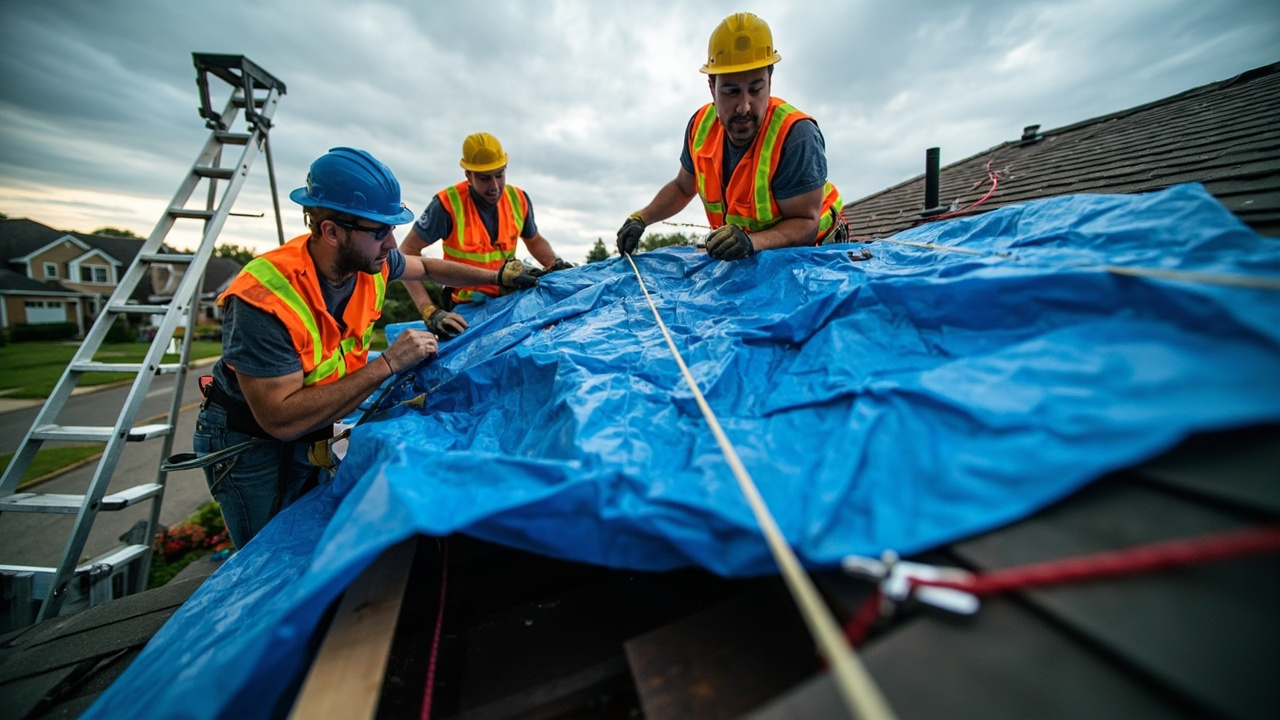
A tarp thrown over a hole is not a fix. It is a temporary failure point waiting to collapse. Professional emergency roof leak tarping requires structural understanding, weatherproofing knowledge, and the right materials. We use reinforced polyethylene tarps rated for high wind loads. We anchor them with battens screwed directly into roof decking, not just draped over the edge.

The process begins with damage assessment. Our technicians inspect the affected area to identify compromised decking, torn underlayment, and exposed framing. If decking is soft or sagging, we reinforce it before tarping. If water has already penetrated the attic, we document it for insurance and extract standing water to prevent mold.

Next, we measure the damaged area and select a tarp large enough to extend at least four feet beyond the breach in all directions. This overlap is critical. Wind-driven rain does not fall straight down. It infiltrates horizontally under edges. A too-small tarp creates new leak points.

We secure the tarp using wood battens screwed into solid decking every 18 inches. The screws penetrate through the tarp, through the batten, and into the roof deck. This creates a clamping force that resists uplift. We seal seams with roofing tape and weight high-exposure edges with sandbags. The result is a watertight temporary barrier that can withstand weeks of rain and wind while you schedule permanent repairs.

For complex roof geometries like valleys, hips, and dormers, we use overlapping tarp sections with sealed seams. We never tarp over active leaks without first clearing debris, because trapped organic material accelerates rot. This level of precision separates emergency roof tarp installation from amateur patchwork.

What Happens When You Call for Emergency Tarping

Emergency Roof Leak Tarping in St. Louis – 24/7 Rapid Response to Stop Water Damage Now
01

Immediate Dispatch

You call our emergency line at any hour. We answer. You describe the damage. We dispatch a two-person crew with tarps, battens, fasteners, and safety equipment. Most St. Louis properties receive a team within 90 minutes. We do not wait for daylight. We do not wait for the storm to pass. We respond while water is still coming in, because that is when tarping matters most.
02

Damage Assessment and Tarping

Our crew inspects the roof from the exterior and attic. We identify the breach, check decking integrity, and measure the coverage area. We clear debris, position the tarp, and anchor it with mechanical fasteners driven into solid structure. We seal edges and test the installation by flooding it with water. If it holds, we move to documentation. If it leaks, we adjust until it is watertight.
03

Documentation and Next Steps

We photograph the damage and tarping work for your insurance claim. We provide a written estimate for permanent repairs. We explain what the tarp will and will not do. We schedule a follow-up inspection within 72 hours to check for tarp integrity and interior moisture issues. You get a detailed report, photos, and a clear timeline for the permanent fix. The tarp stays in place until your roof is rebuilt.

Why St. Louis Homeowners Trust Local Emergency Response

When your roof is open to the sky at 3 a.m., you need someone who knows St. Louis. You need a team that understands how fast summer storms move through the metro. You need technicians who have tarped roofs in Soulard, Tower Grove, and Clayton and know the difference between a 1920s bungalow and a 1980s ranch.

Patriot Water Damage Restoration St. Louis has been responding to emergency roof failures for years. We know the local building code requirements for temporary weatherproofing. We know which St. Louis neighborhoods have older roofs prone to wind damage. We know the insurance adjusters who work this region and how to document damage so your claim is not denied.

We stock heavy-duty tarps in multiple sizes because St. Louis homes vary. A Craftsman in the Hill has a different roof pitch than a Colonial in Webster Groves. We carry extension ladders, fall protection gear, and high-lumen work lights because most emergencies happen in the dark. We do not improvise. We come prepared.

Our crews are trained in rapid water extraction and mold prevention. If your attic is flooded, we do not just tarp the roof and leave. We pull the water, set up dehumidifiers, and treat affected wood with antimicrobial solutions. This integrated approach prevents secondary damage that turns a roof leak into a total interior gut job.

You will not get this level of service from a national franchise or a contractor three counties away. Local expertise means faster response, better problem-solving, and accountability. When we tarp your roof, we are protecting our reputation in the community. That matters more than any marketing slogan.

What to Expect During an Emergency Tarping Call

Response Time and Availability

We answer emergency calls 24 hours a day, seven days a week. When you call, you speak to a real person, not a voicemail system. We dispatch a crew immediately. Most St. Louis properties receive a team within 60 to 90 minutes, depending on traffic and weather conditions. If roads are impassable, we communicate realistic timelines. We do not promise what we cannot deliver. Once dispatched, our crew stays on site until the tarp is secure and watertight. There is no hourly cutoff. The job is done when it is done.

Onsite Damage Assessment

Our technicians inspect the roof, attic, and affected interior spaces. We identify the source of the leak, check for compromised decking, and assess water intrusion. We document everything with photos and notes for your insurance claim. If the attic is flooded, we extract standing water immediately. If insulation is saturated, we remove it to prevent mold. The assessment is thorough because emergency tarping is only part of the solution. We need to know what permanent repairs will require so you can plan accordingly.

Watertight Temporary Barrier

You get a professionally installed tarp that will hold for weeks or months if needed. We use contractor-grade polyethylene tarps, not hardware store blue tarps. We anchor them with wood battens and corrosion-resistant screws driven into solid decking. We seal seams with roofing tape and weight edges with sandbags. The installation is wind-rated and flood-tested before we leave. You will not wake up to a tarp flapping in the wind or pooling water. The barrier works until your roof is permanently repaired.

Follow-Up and Permanent Repair Coordination

Emergency tarping is the first step, not the final solution. We schedule a follow-up inspection within 72 hours to check tarp integrity and interior moisture levels. We provide a detailed written estimate for permanent roof repairs. If you need help navigating insurance claims, we walk you through the documentation process. We coordinate with your roofing contractor to ensure the tarp is removed safely and the repair is scheduled promptly. You are not left to figure out next steps alone. We manage the process from emergency response to final rebuild.

Frequently Asked Questions

You Have Questions,
We Have Answers

Can I put a tarp on my roof to stop leaks? +

You can, but it is risky and often ineffective. Climbing on a wet, damaged roof during a storm is dangerous. Most homeowners lack the proper 6-mil polyethylene tarp, sandbags, and anchor boards needed to secure the tarp against St. Louis wind gusts. A poorly installed tarp can blow off within hours, causing more water intrusion and further damage. Professional emergency tarping services arrive fast, use commercial-grade materials, and anchor tarps correctly to prevent wind uplift. They also document damage for your insurance claim. Call a certified water damage restoration team immediately to protect your home.

How to temporarily cover a leaking roof? +

Turn off electricity to affected areas first. Move valuables and furniture away from the leak. Place buckets or tarps inside to catch water. If safe, locate the leak source from inside your attic. From the outside, you need a heavy-duty tarp, 2x4 boards, and sandbags. Drape the tarp over the damaged section, extending at least 4 feet past the leak on all sides. Anchor it with boards nailed to roof decking or weighted sandbags. St. Louis storms move fast. Do not climb on your roof alone or during lightning. Call a 24/7 emergency tarping service for immediate, safe coverage.

How to emergency tarp a roof? +

First, ensure your safety. Never climb a wet or icy roof. Use a sturdy ladder with a spotter. Identify the leak location from inside first. Unroll a 6-mil polyethylene tarp large enough to cover the damaged area plus 4 feet of overlap. Anchor the tarp with 2x4 boards screwed into solid decking, or use sandbags on low-slope roofs. Avoid nails that penetrate shingles and create new leaks. St. Louis wind and rain require secure fastening. If you feel unsafe or lack materials, call a professional emergency tarping crew immediately. Speed matters to prevent interior water damage.

How much does it cost to emergency tarp a roof? +

Emergency roof tarping in St. Louis typically costs between $200 and $1,500, depending on roof size, pitch, accessibility, and damage severity. A small single-story home with easy access costs less than a steep two-story roof during a storm. Most insurance policies cover emergency tarping as part of your dwelling coverage if you file promptly. Professionals provide detailed invoices and photo documentation for your claim. Avoid companies that demand large upfront payments or refuse to itemize costs. Reputable crews offer transparent pricing and work directly with your adjuster to streamline reimbursement. Speed and safety justify professional service.

How St. Louis Storms Make Emergency Roof Tarping a Life-Saving Service

St. Louis averages 40 inches of rain annually, with most falling during violent spring and summer thunderstorms. When a supercell dumps four inches in two hours, gutters overflow and water backs up under shingles. When tornadic winds gust to 70 miles per hour, entire roof sections peel away. The combination of high winds and heavy rain creates catastrophic leaks that flood homes in minutes. Emergency roof tarp installation is the only way to stop the damage before the next storm arrives. In St. Louis, the next storm always arrives.

St. Louis building codes require temporary weatherproofing to meet specific wind load standards. A tarp installed incorrectly can fail inspection and void your insurance coverage. Local contractors understand these requirements. We work with St. Louis adjusters daily and know exactly how to document emergency tarping for claim approval. When you hire a team that knows the local code, the local weather patterns, and the local insurance landscape, you get faster claims processing and fewer disputes. That local knowledge is the difference between a covered repair and an out-of-pocket disaster.
Water Damage Restoration Services in The St. Louis Area

We are proud to be the trusted local choice for water damage restoration across the greater St. Louis region. This map highlights our primary service zone, demonstrating our commitment to rapid, localized response across every neighborhood and business district within the area. We invite all users to view our service area and then contact us directly for immediate deployment to your specific address within the St. Louis community.

Address:
Patriot Water Damage Restoration St. Louis, 710 N Tucker Blvd, St. Louis, MO, 63101

Additional Services We Offer

Our news updates

Latest Articles & News from The Blogs

What to Do When Your Water Softener Leaks and Floods Your Affton Utility Room A leaking water softener can release…

What to Do When Your Water Softener Leaks and Floods Your Affton Utility Room

What to Do When Your Water Softener Leaks and Floods Your Affton Utility Room A leaking water softener can release…

Restoring a Water Damaged Mid-Century Modern Home in Warson Woods

Restoring a Water Damaged Mid-Century Modern Home in Warson Woods Water damage in a mid-century modern home requires specialized knowledge…

Why Your Walk-Out Basement in Hi-Pointe is Vulnerable to Heavy Rain Runoff

Why Your Walk-Out Basement in Hi-Pointe is Vulnerable to Heavy Rain Runoff Your walk-out basement in Hi-Pointe faces unique flooding…

Contact Us

If your roof is leaking, do not wait. Call Patriot Water Damage Restoration St. Louis now at (314) 428-9977. We dispatch emergency tarping crews 24/7 to stop water damage and protect your home. Every minute you wait costs you more in repairs.